Forget “big data”, we need smart data

Word Cloud "Big Data"While the Technology industry is a very exciting space to work in and has always afforded me incredible opportunities in my working life, it often frustrates me also.  I feel the recent hype around big data is a worrying example of this – we can over-simplify things and therefore understate the value we bring to the marketplace.  But beyond that, too often we give the market the impression that our solutions are a silver bullet when in fact that there is far more to a problem than just throwing some technology at it. I made these points in The Rust Report this week – please do let me know what you think…

“It seems the IT industry has done it again.  Too often in the past the Technology Sector has created a huge bandwagon onto which every marketeer in the industry has jumped without anyone scrutinising the actual value being proposed, or making the case with any depth.  Pretty soon customers see through the empty and shallow proposition and the bubble bursts, leading to a backlash, job losses and diminished credibility.  I’m very concerned history is repeating itself.

Think Y2K, or RFID, or even Cloud.  While all of these propositions were more than valid, the huge bubble in vacuous marketing hype left the customer feeling short changed.  With Big Data I feel the case has not been made correctly.

Anyone who was at last year’s CeBit Keynote in Sydney would remember Obama CTO Harper Reed’s confronting comment – and I paraphrase – “Big Data is bovine excrement”.  His point was that the “Big Data” challenge was a storage one – back in 2007.  Today that challenge is solved.  The real challenge of data today is how to derive real value from it, not where to put it.  Today the industry is busy selling solutions to the wrong problem.

“When I hear Big Data, I immediately hear marketing” said Harper.  “All these great brands, they’ve really jumped into this marketing world of talking about the problems that are pretty much solved.”

We don’t need Big Data, we need Smart Data. There’s data tracking everything possible from our physical movements, to our buying and trading habits, to our relationships and thoughts.  But while GPS, Social and mobile surfing behaviour data are all religiously monitored, everyday products and even whole businesses are failing.  We’re busy collecting all this data, but we aren’t learning anything from it.  This is what the industry needs to solve.  As many others have pointed out, with all the trading data and predictive models available, we still didn’t see the GFC coming.

When was the last time you heard anyone talk about Radio Frequency IDentification (RFID)?  It was all anyone could talk about in 2006, but after everyone put tags on anything that moved, they derived no value from it because no one figured out where to put all the data they created, let alone how to learn anything from it.  As a result, ROI was minimal.  I’m having deja vu with Big Data.

The first problem is talent.  The news is currently peppered with surveys that identify a spectacular gap between the Big Data skills required and the talent available to meet those needs.  What are Australian Universities and Governments doing to solve these problems?  It remains the case that, used and educated effectively, the best computer we have access to is still the human brain.  But we don’t have enough people who know how to ask the right questions – query the data – let alone how to extract the answers.  This requires a unique blend of mathematics, psychology and business acumen.  I am not sure Australian universities are investing enough in cultivating these skills and businesses don’t know where to find them.

Equally, where are the smart algorithm apps that help smaller companies extract value from the data they have stored in databases like Oracle or Salesforce. A good example is SalesPredict in the US, which recently raised $1 million in seed funding to help small companies predict which sales leads are more likely to convert.  Advanced Pattern Discovery is a another tremendous application of Big Data but it requires very clever modelling software to produce.   This is a huge area of potential innovation Australian entrepreneurs could be investing in – with Government help – but I’m not hearing about them.  I would certainly like to see our local industry investing more in this area, far more than in marketing hype around big storage boxes.

Software doesn’t solve the big data issue and as the old saying goes, “a fool with a tool is still a fool”! It is crucial to consider the strategy that drives where to look for answers, which data sets to use and how to get the correct insights. This process is performed by humans, the technology just facilitates it. The gap we have is the human gap.  What is the industry in Australia doing to fill that gap?

As the nation furiously debates the future of education and skills development in both the TAFE and University spaces, this is an important new skill set that business desperately needs more talent in.  I would like to hear more discussion about how Government and Industry can invest in this development – much more than I want to hear about the latest “Big Data” solution.”

Do you have the X-factor?

smhThis week the Sydney Morning Herald published an article I wrote about values. Anyone that has worked with me knows that I am a strong believer in values and their role in business success.  I wanted to summarise these beliefs for the wider business community in the hope that it might provide some balance to the picture, because I feel that far too often there is too much talk about measurement and data and KPIs when there are some other less tangible factors that are harder to measure but nevertheless important to doing well.  Here is the article:

“We’re told running a successful business is all about growth, profit, measurement and accountability. ROI, KPIs and Big Data mean that everything we do is measured to the enth degree and constant reviews of the business and our performance within it are critical to staying on track.

For the most part this has made us focused and disciplined, which is a good thing. But along the way there are some elements that we’ve forgotten: I call it the X-Factor. As Albert Einstein said, “Not everything that counts can be counted; and not everything that can be counted, counts”. As a result of this obsessive focus on numbers, we tend to measure everything, even if it isn’t really an indicator of anything worthwhile. But at the same time, there are some aspects of business we don’t and can’t measure, but which deliver a huge degree of intrinsic value.

We have learned intangible and mercurial aspects of business, we call the X-factor, can deliver huge benefits. I am advocating an approach that encourages people’s passion and it’s really working for us. There are three aspects to creating a winning X-Factor culture:

The first is around values. When we articulated what our culture had become we didn’t realise it would be so important. We have found it to be very powerful as it has become ever-present in everything we do. It started when we expanded across the country and wanted to make sure who we were wasn’t being diluted or distorted across our national and regional offices. We spent time thinking about what lexicon best reflected the organisation we thought we were, what we wanted to be and how we wanted to be perceived.

The second aspect is your environment. When we moved into new offices – a refurbished warehouse space in Sydney’s CBD – architectural design firm Rolf Ockert created a space that reflected our values. We tried not to provide too tight a brief, except to say the overall effect should be “funky” and consistent with our values. The result has been an environment people feel inspired by, which has won awards and is an instant talking point.

Finally, there is attitude. We identified in the creation of our X-Factor that our team was overwhelmingly committed to caring about the customer. Not in a way that could be measured by customer satisfaction surveys; and not even in a way that could be tracked in customer retention dashboards or other metrics.

You can retain your customers by simply staying ahead of your competition – in price or in customer service. But we discovered our people wanted to commit to something above and beyond that. We defined this in terms of seeking to always delight our customers. Our customers appreciate it, and it is borne out in our revenue figures and overall success.

But more important than all of this the pride my colleagues have in the workplace, its professionalism and passion.

I was surprised how much the X-Factor has impacted our business. Nowhere in my MBA studies was this kind of “fluffy stuff” recognised as powerful and differentiating. We weren’t taught how to create it or cultivate it as leaders and managers but I now know that our company wouldn’t be what it is without it. It seems today we lean so heavily on the left side of our brain, we forget how much the right side can contribute.”


The Only Constant is Change

Next month is our ninth consecutive Red Rock Leadership Forum – our biggest day of the year. We will be holding it the splendid Sydney Town Hall in the CBD and expect hundreds of partners and customers from within the not inconsiderable Oracle ecosystem in Australia to attend to learn about the latest in Cloud, Datacentres and Applications.

gearoidWhile I’m excited every year as we gather together all our stakeholders into one big room to discuss the hot topics of the day, I’m particularly excited this year because we’ve arranged for one of my most inspirational friends, Gearoid Towey,  to give a brief motivational talk on how to manage transition.  With Oracle now finally bridging the gap quite aggressively from on-premise to cloud and the wider industry embracing this massive change at some pace, we all face a great deal of transition in our professional lives.

Transition was something Gearoid Towey was forced to face alone.  When his career as an elite Irish Olympic Rower came to a sudden end after the 2004 Olympics in Athens, he found that there was very little assistance for him in how to cope with life after professional sport.  As he researched it further he found so many former athletes had struggled with the impact such a change had on their sense of identity and purpose.  We can think most recently of the obvious troubles haunting Ian Thorpe.

You can read more here about how Gearoid coped with this transition  but register now for the Red rock Leadership Forum to hear his advice for embracing change and managing transition.  The only constant is change in this life so his advice will be most valuable I can assure you!

red rock

Building a Sales Culture: Leaders Must Walk the Values Walk

Recently I was asked by the University Of Sydney Business School to talk to an MBA class about “Creating a Sales Culture”.  First of all I must say I’m always happy to take these kind of  opportunities because you can learn so much from a class such as this, as much from them as they from you in fact.  Their insight and response and questions are always very refreshing.

Within my own company we didn’t formally think about our Sales Culture until we began to expand inter-state.  That isn’t to say there was no culture previously of course, we just hadn’t taken the time to define it.  We hadn’t considered it cognitively.

But when we started opening new offices, we realised that while culture may breed by osmosis within one physical location, it didn’t travel well across geographies without some sort of definition.  So at that stage we sat down to try and articulate what our culture had become and what we stood for as a company.  Quite surprisingly, it has been one of the most important strategies we’ve put in place and the results of which to this day are palpable from the minute you step inside our offices.  We call it the “X-Factor” and we have found it to be very powerful as it has become ever-present in everything we do as an organisation.

Every organisation has a Culture.  The class asked me to define a Sales Culture, and I did so by talking about it as the reflection of what an organisation wants to be, how it wants to be perceived and most importantly, how it wants to be considered different from others.  We defined our Sales Culture through a series of Core Values such as “Good enough is not enough,” “Listen before talking” and “Always seek to delight our customers.”

Values are powerful because they are a helpful starting point for new staff, they help gu   ide the ongoing management of people and instinctively frame the way you go-to-market.  A set of Values ensures a consistency in engagement with stakeholders and sets the roadmap for the journey your customers take with you.  For that very reason, an organisation’s Sales Culture is about more than just the Sales team and must extend across the organisation – to marketing and customer service for instance – even (perhaps especially) to reception!

My final message to the MBA class is perhaps the most enduring lesson I have taken from this journey.  Culture is reflected in stories about the organisation, its events…its heritage; and the easiest way to demonstrate it is for business leaders to walk the Values walk themselves.  This, I have learned, is central to what business leadership is about.  I am hoping the business leadership of tomorrow embraces this because it has certainly been an epiphany for me.

The TCO of Cloud

This is an article I had published in October on The Rust Report

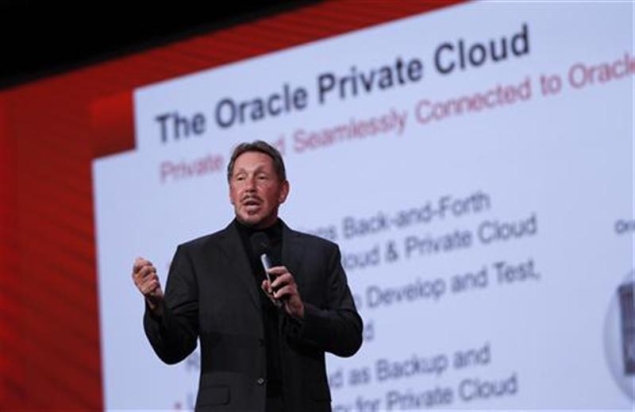
ImageWhile it is perfectly understandable that Larry Ellison missed his own Keynote at Openworld so he could watch his yacht do battle in the America’s Cup; what is harder to understand is that the entirety of the content – ultimately delivered by his chief engineer, Thomas Kurian – was about Cloud.

Cloud, after all, only represents between 3 and 10 per cent of Oracle’s overall revenue (depending on how you crunch the numbers).

It seems only five minutes ago that – quite rightly I think – Larry Ellison derided the IT industry for being “worse than the fashion industry” in its obsession with the Cloud.  But more telling perhaps was his comment that, “I’m not going to fight this thing”.

He certainly hasn’t and of late he has become more the “Sugar Daddy” of Cloud.  The original angel investor in Salesforce.com and Netsuite a few months ago announced Cloud-based deals with many of his competitors including Salesforce and Microsoft.  Larry is having a bet both ways.

But is Cloud all it has cracked up to be?  I want to talk in particular about applications delivered as-a-service, rather than merely “hosted” computing resources.  SaaS brought much needed nimbleness to the industry.  Deploying it is cheap, there’s no hardware to buy and the subscription model famously makes it easy to buy on a corporate credit card, circumventing roadblock IT departments.

However, as many companies are beginning to discover, Cloud isn’t the panacea it was once thought to be.  Did anyone do proper Total Cost of Ownership (TCO) studies?  What were once quite manageable self-contained deployments of CRM-on-demand, for instance, are now having to be deployed company-wide with a huge associated integration costs; not to mention the pain of harmonizing data models and user environments.  (Let’s not even get into the security and sovereignty issues!)

What does this cost in terms of consultancy hours, lost opportunity and the agony of internal political division?  How does this compare with the visible and predictable – albeit expensive – costs of existing legacy on-premise deployments?

Also, it isn’t just CRM now, with vendors like Workday or Marketo becoming so mainstream, and then established players like Adobe and SAP moving into this space; identity and access is a nightmare for most IT departments.  At least with on-premise the same IT people had a strategy.  Now there is a plethora of applications breaking out that those required to manage them didn’t even chose.

And SaaS vendors are now just as guilty of three-year license deals and a “good luck with that” attitude to roll-out success.

So perhaps it is too soon to write off the on-premise model – secure, predictable and reliable as it is.  Lets consider hybrid models more carefully and lets treat Cloud computing as an option, and not the promised land the industry would have us believe.  There is of course an important role for cloud and particularly SaaS, but the business case should be thought through more soberly and the parameters of that role should be more closely defined.

Because caught in a private moment, many Oracle executives will confess: “on-premise still keeps the lights on”.

Ten Leadership Tips from the AICD

leadershipFollowing on from a list of Influential Leadership Books crowdsourced from a discussion in the Australian Institute of Company Directors Group on LinkedIn (which you can see here); from a subsequent discussion I have been able to compile ten Leadership Tips from within the same Group:

1. “Don’t assume you’re the smartest guy in the room! Underestimate the intelligence and astuteness of your people at your peril!”

Paul Milchem, Managing Director, Human Dynamic Group

2. “Be authentic. Leaders who don’t understand that staff see through their behaviour…are kidding themselves and undermining their own ability to lead effectively.”

Lyn Boxall, Singapore Committee of the AICD

3. “Focus on the behaviours of mindfulness, hope and compassion to be a resonant leader”

Claire Davis, Accredited Coach, Accelerate Global

4. “Be Self-aware. It is important to understand what we are like, how people perceive us and how we can change it for the better.”

Jennifer Dignam, Head of HR, Tanker Pacific Management

5. “Good leaders should operate with humility.”

Gary Morgan, CEO, Co-operative Bushfire Research Centre

6. “Leaders do not copy and just follow. Leaders innovate and challenge.”

Alma Tiamzon, owner, ADT Management Services

7. “Failure to accept our own fallibility is often the cause of self-destruction.”

Pamela Murray Jones, Founder, Focus Business Strategy and Coaching

8. “Real leaders bring the rest of the team along on the journey – because they have a vision that’s communicated and inclusive.”

Alistair Grinbergs, Executive Director, Ironbark Heritage & Environment Pty Ltd

9. “A leader should never let bad behaviour from staff or colleagues go unchallenged.”

Guy Wilson-Browne, Infrastructure Director, Yarra City Council

10. “A leader must walk the walk to gain his team’s respect and commitment.”

Jonathan Rubinsztein, CEO, Red Rock Consulting

Crowdsourced Reading List on Leadership

stack-of-booksRecently I started a discussion in the AICD Group on LinkedIn about which books provided members with the greatest inspiration and guidance and I was very surprised by the enthusiasm with which people wanted to call out the books that had helped them with guidance on how to navigate the challenges of management and leadership.  Perhaps books are indeed your friends!

Happy reading!

  • ‘It’s not the big that eat the small – it’s the fast that eat the slow’ by Jason Jennings and Laurence Haughton
  • ‘Rockefeller Habits’ by Verne Harmish
  • ‘The Five Dysfunctions’ of a Team and ‘Getting Naked’ by Pat Lenoncini
  • ‘The Utimate Question 2.0’ by Fred Reichheld
  • ‘Winning Teams’ by Jack Welch
  • ‘Drive’ by Daniel Pink
  • “The Lean Start-up” by Eric Ries
  • ‘Put your heart into it’ by Howard Schultz
  • ‘Leadership and self-deception’ by The Arbinger Institute
  • ‘Matsushita Leadership’ by John P Kotter
  • ‘Conscious Capitalism’ by John Mackey
  • “Iconoclast: A Neuroscientist Reveals How to Think Differently” by Gregory Berns
  • Capitalism vs Capitalism by Michel Albert
  • ‘Change by Design’ by Tim Brown
  • ‘Outliers’, ‘Blink’ and ‘Tipping Point’ by Malcolm Gladwell
  • “Why Should Anyone Be Led By You” by Goffee and Jones.
  • “First, Break All The Rules” by Markus Buckingham
  • ‘Moments of Truth’ by Jan Carlzon
  • ‘Megatrends’ by John Naisbitt
  • ‘The Complete CEO’ by Peter Fisk, Gary Miles and Mark Thomas
  • ‘Good to Great’ by Jim Collins
  • “Other Peoples Habits: how to use positive feedback to bring out the best in people around you.”by Aubrey C Daniels
  • ‘The Seven Motivations of Life’ by Mark Oliver
  • The Speed of Trust by Stephen M. R. Covey
  • Now discover your strengths – Marcus Buckingham and Donald Clifton
  • Resonant Leadership – Annie McKee and Richard Boyatzis
  • “Leaders” by Warren G Bennis and Burt Nanus
  • “Start with Why” by Simon Sinek

First among equals!

I was thoroughly humbled last night to be awarded the New South Wales ICT Professional of the Year for 2013 by the Australian Information Industry Association.  While the award itself is a great honour, I was so impressed by many of the other award winners and was excited to see all the great projects happening here in this great state of ours.  There’s a lot more innovation and talent here than we sometimes give ourselves credit for I think.  So I just though I’d list out (below) those other winners as I think they deserve a great deal of praise…

Thanks again to the AIIA for this great privilege, I’m most grateful.

Community

ThoughtWorks for GetUp! and ControlShiftControlShift.

Consumer

IP Payments and Quickflix: Quickflix multi-currency and multi-channel secure payment solution.

Financial

OzForex: White label foreign payment solutions.

Government

Capgemini Australia: Detective HANA.

Health

eHealthWise: THELMA.

Industrial

Geomatic Technologies and RailCorp NSW: GT AIMS in support of RailCorp mechanised track patrol process.

New product

Avoka Technologies: Transact – transaction experience management platform.

Postgraduate tertiary student

University of New South Wales (UNSW) school of computer science and engineering student Liang Tang was recognised for the development of a reconfigurable pipelined coprocessor for multimode communication application.

Research and development

CSIRO ICT centre: Remote mobile tele-assistance platform.

Secondary student project

Oxford Falls Grammar School student Deinyon Davies: In Road.

Sustainability

Object Consulting: Our Green Home.

Tools

Fujitsu Australia and New Zealand: CloudFor-J.

Undergraduate tertiary student

University of Wollongong (UOW) students Jake Shelley, Veronica O’Gorman, Joseph Pons and Andrew Booth: UOW Finder.

ICT educator of the year

UNSW associate professor Richard Buckland.

ICT woman of the year

M&M Consulting Services business improvement consultant Maggie Alexander.

From little things, big things grow…

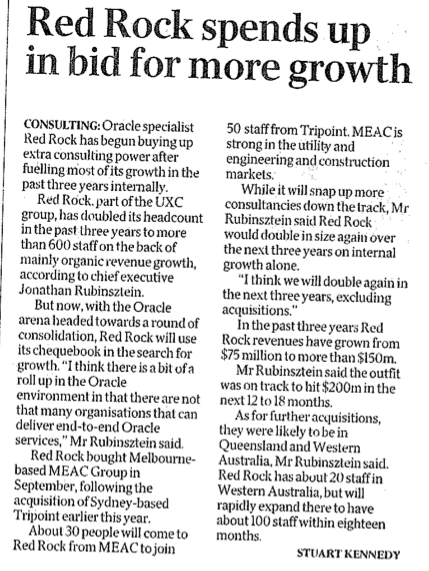
We had some nice coverage in the Australian this week, detailing the growth we are experiencing at the moment. The IT editor Stuart Kennedy spoke to me about how we were growing and I provided an overview of how we were building out our practice:

TheAusIT - NOv12

Naturally this is a summary of our conversation and I went into more detail about the consolidation trend I was seeing in the market as customers were demanding more of an end-to-end service.  In many ways this explains our growth at the moment. We have been able to provide customers with a much more comprehensive consulting service because as Oracle has expanded its offering, so we have expanded our expertise and scope. The acquisition of Tripoint Online’s Peoplesoft expertise earlier this year is a great example of that. As that growth has come in depth, we have also expanded across ANZ, opening new offices in Perth recently and investing in our New Zealand practice (most recently with this acquisition of Jireh).

Our growth has been steady – $75 million to 150 million in just three years – and we should be on track to hit $200 million in the next 12 to 18 months. It is not easy growing at this rate, but I believe that as long as we focus mainly on a commitment to customers and an adherence to our strong sense of corporate culture, we can sustain it. Time will of course be the judge!

“Cutting your Losses” is not always as easy as it sounds

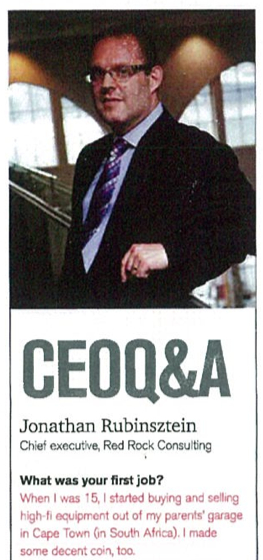
BRW Q and A 2012I was very pleased to be featured in October’s CEO Q&A in Business Review Weekly.  The questions were quite personal in nature, rather than about the business but did provide a platform to share some learnings which I hope are useful.

BRW Q and A 2012

Probably the starkest lesson I was able to share was what I learnt around my investments in Babcock and Brown as I, like many others, refused to believe it was tanking and instead  continued to throw good money after bad at it. In retrospect I could have analysed the situation much more accurately if I stripped the emotion from the decision. Like the old analogy about hanging onto a balloon before you decide to let go – the longer you are wrong, the worse it gets.  The writing was on the wall for all to see but it is always a difficult decision to cut your losses and admit you are wrong.    But hindsight is of course a beautiful thing!