
Reimagining the EPC: Infomedia’s Biggest Investment to Date

Microcat EPC – Infomedia’s Biggest Investment to Date

The global automotive industry is currently facing unprecedented market uncertainty and ground-shifting change. OEMs and dealerships from all over the world have been blindsided by the huge impact of the COVID-19 outbreak.

Like many downturns previously, the parts and service business of the dealership is becoming a key focus for maintaining bottom line growth. And for some dealerships, their survival.

Our global OEM partners constantly ask us: “How do I sell more genuine parts?” and “How do I optimise my internal and wholesale parts sales processes?”

These questions are now more salient than ever before.

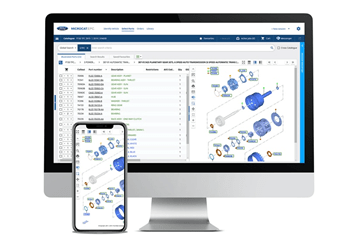
Against this backdrop, I’m excited to announce the new, next-generation release of Microcat EPC that tackles this sales challenge head on. It’s our largest ever investment in the Microcat technology, designed to optimise and grow parts counter effectiveness, today and into the future.

The new Microcat EPC is built based on feedback from our global customers and delivers on three main objectives:

  1. Make parts selling faster and more accurate by evolving the core functionality of the EPC
  2. Increase the size of parts orders and streamline the sales process by empowering parts staff with handy add-on features
  3. Help Parts Departments implement self-serve eCommerce solutions for their wholesale customers by creating an EPC-powered platform

New EPC Vision for a New Era

As pioneers in the parts catalogue space for over 30 years, we’ve always seen the EPC as a mission critical tool for dealerships. Over the years, we have evolved and released new innovations in Microcat to keep up with technology and keep ahead of customer expectations.
Given the current economic conditions, this laser focus on innovation takes on a new importance for our customers. Our vision for our next-generation Microcat EPC is to help OEMs and their dealerships reduce cost and facilitate more OEM parts sales.

The factors driving the new Microcat EPC vision:

  1. New car sales are dropping, making Parts and Service a key focus
  2. Dealerships are facing greater competitive pressures especially from the Aftermarket suppliers. Speed and customer service are more important than ever before
  3. The need to leverage existing assets to make dealerships more efficient and cost-effective, with focus on greater Return on Investment (ROI)
  4. Collision and Mechanical customers expect dealerships to cater for online sales
  5. Bringing Parts and Service together to improve efficiencies and customer experience

As innovators, we believe the EPC is more than just a catalogue reference tool. It is central in facilitating better process control and sales automation, so parts staff can spend more time with customers and less time interpreting technical data.

A major opportunity for the new Microcat EPC is to facilitate faster and better communication between the Parts Department and their customers, both inside the dealership and with independent trade shops.

Evolving Core Microcat EPC Features – Faster, More Accurate and Better CSI

In developing the most advanced version of Microcat EPC yet, our teams used Customer-Centric Design (CCD) principles to make it more streamlined, automated and productive:

New Interface: The sleeker, more intuitive user experience streamlines catalogue navigation. Features and data elements are presented with depth and shadowing for a cleaner screen layout. Intelligent linking of catalogue sections means a more efficient workflow that saves time, improves sale process and drives better CSI.

Global Search: Want to look up VIN-precise parts with lightning speed and accuracy? We’re introducing ‘Global Search’, the fastest EPC search engine in the industry. You can search for vehicles and parts using the powerful and precise ‘one-step’ search box, without selecting a search type. Selling parts has never been faster.

Active Jobs: Need to serve multiple customers at a time? The new ‘Active Jobs’ automatically saves each look-up, so you can jump in and out of jobs, quickly and easily. Improve efficiency and parts sales effectiveness by better managing multiple customers and jobs at the same time.

Mobile EPC: Want the flexibility to access the EPC on any device? Redefine the parts selling process by selling genuine OEM parts on the go! The new, mobile-friendly and responsive design adds convenience and empowers your team and other dealership staff to access the OEM parts catalogue from any place, at any time.

Add-on Solutions to Streamline and Grow  

As part of our broader Microcat EPC vision, we’re introducing industry-first solution add-ons to improve parts order size, drive better Parts Counter productivity and improve customer communications:

Service and Repair Menus

Often, many inexperienced Parts Interpreters might miss ‘related part’ sales opportunities. The new Microcat EPC introduces integrated VIN-precise menus, covering over 300 service, repair and accessory fitment jobs – so your staff have the knowledge to recommend and sell more parts and fluids. This level of parts visibility reduces unproductive discussions between the Parts Counter and the Technicians. Your Parts staff won’t have to call or walk over to the Service Department to find out which parts are required for a certain repair. A bonus if you’re practicing social distancing!

Messenger App

Can’t see your wholesale customers face-to-face? Need your Technicians in the workshop to remain in their bay? The new Microcat EPC has an integrated messaging app that connects the Parts Counter with other internal dealership staff and wholesale parts customers. The fast and efficient communication channel delivers accurate parts information, provides self-service parts ordering efficiencies for wholesale customers and grows CSI.

EPC Analytics

The best way to know if something is working is to measure it. The new Microcat EPC provides advanced EPC analytics to help OEMs understand the demand for parts by comparing demand to sales. Management can utilise these insights to better target marketing activities and grow parts sales performance.

Microcat Platform – EPC Powered Parts Selling Suite

Globally, our dealership customers have said that they can’t work and can’t sell parts without Microcat EPC – it’s seen as the engine of their Parts Department.

That has inspired us to create the Microcat platform – an integrated OEM parts selling suite of solutions – with Microcat EPC as the engine to power e-commerce capabilities for Collision and Mechanical part sales.

The powerful platform enables dealerships to extend parts selling beyond the Parts Counter by making the Parts Catalogue more accessible to wholesale customers, supporting OEM conquest programs and promoting self-serve tools that make it easy for customers to buy from the dealership.

Be Part of the Future with Microcat

With the steep decline in global new car sales, OEMs and dealerships can increase their revenue by boosting genuine OEM parts sales. Technology leadership is a key pillar to achieving this objective.

The new Microcat EPC is our biggest investment to date and it could very well be one of your best investments yet. It redefines the traditional EPC and reimagines the parts selling process.

It’s an EPC that positions your Parts Interpreters as knowledgeable and professional, providing the key tools to improve efficiency and maximise part sales opportunities.

In the next issue of Driving Force, we’ll look into how OEMs and their dealership network can recuperate their revenue loss of new car sales by expanding their Service business.

In the meantime, feel free to contact us to learn how you can innovate your parts sales processes and drive new efficiencies with the new Microcat EPC: start@infomedia.com.au.

TED: What is the new Democracy Model for the internet age?

I was so pleased to get this article published on the ABC site – and it goes to an issue I really think our politicians should think more carefully about. It really is time we thought about upgrading the way we use technology in our democratic systems…

Right up top, [Pia] hit us with the quite confronting reality that our political system is “nineteenth century-designed and based on technologies of the fifteenth century.” How ridiculous is that? And she is quite right of course. Few feel fully engaged in the process that is articulated using – as Pia put it – language written “by lawyers, for lawyers” (“programmatic specificity” springs to mind!)

You can watch Pia’s whole presentation here:

No matter how you shuffle the IT Vendor deck, the same cards stay up top

As part of an ongoing partnership with the good people at The Rust Report, I had the following article published yesterday – as usual my aim was to question some of those things we take for granted, let me know what you think…

Recently I was reading one of those CXO surveys in ZDnet (http://www.zdnet.com/enterprise-tech-vendors-sizing-up-the-next-gen-field-7000035317/), using it to challenge my view of the IT marketplace.

These articles are often the same. You can take them with a pinch of salt, but there’s always a degree of useful insight. The articles’ main aim is to alarm you. This one was no different: “the most favored vendors are likely to be reshuffled in the next two to three years…IT leaders will have to make bets very carefully.”

However, ultimately I found that my existing view remains unshaken: The Big Four vendors of most relevance in the IT marketplace will continue to be Oracle, Microsoft, SAP and Google for the foreseeable future. Let me explain why…

The principle point of the article was about speed of innovation: “don’t get locked into a vendor that won’t be able to be an innovation partner” warns reputed journalist Larry Dignan. The premise being that the exciting and innovative companies to watch out for – such as Salesforce, Servicenow, Workday etc – could be the new IT giants of the tech world because they are innovating faster and leaving the incumbent players behind. But while this view is exciting and a compelling angle for the media, how realistic is it…really?

The Enterprise IT landscape changes actually quite slowly when you think about it. Salesforce is 15 years old this year and if you take the view that it was its founder Marc Benioff that innovated the cloud, then the process of cloud adoption in the Enterprise has been extremely slow – compared to, say, how quickly the consumer mobile phone market ‘turned on a dime’ in the middle of the last decade. In that time, both Microsoft and Oracle have built impressive cloud offerings that now rival pure-cloud players like Salesforce and Amazon in terms of revenue. While they might innovate slower, that doesn’t mean that The Big Four’s relevance is any less.

This image of CXO views of future vendor relevance is very interesting.

Source: ZDnet

With the exception of VMware and Cisco, the only vendors with a “more important” rating of 30 per cent or more are The Big Four: Oracle, Microsoft, Google and SAP! Furthermore, when you look at reasons for rating these vendors “more important” in the future, ‘dependability’ is second but ‘innovation’ is third at 51 per cent (relevance is first at 70 per cent). That is because IT buyers instinctively know that these players will always add value, even if they don’t yet know what that value will be. To this point, the article makes one solid message: “Think of your large vendors as a series of divisions that aren’t created equal. Some units may be worthwhile even as you resist the cross-sell and lock-in pitches.”

Oracle and Microsoft are excellent examples of this – The Big Four vendors have extremely innovative and nimble business units within them, competing aggressively with their colleagues for customer wallet-share. The large players have deep pockets and can afford to experiment. If they can’t innovate, they can acquire – as the rush of marketing automation software purchases in recent years has shown.

While these business units are less nimble because of horrendous behemoth-bureaucracy, they have two crucial advantages. They are protected from failure far more by cross-subsidies from the more established product lines; and they have access to gold-standard customer focus groups the smaller players can only dream of. Just look at what is happening now. The once nascent SaaS lines within Oracle now define the corporate strategy; HANA is driving much of SAP’s momentum, and Microsoft’s Cloud business has just delivered the new CEO! Moreover, while Google’s Cloud, search and apps products are most prominent, their emerging robotic, wearable and AI divisions will drive the agenda for the next decade.

But as a customer, take heed of Mr Dignan’s advice – your role in the success of these more innovative business units is an important one every time you sit down to renegotiate a deal on your traditional legacy systems and services. The Big Four will perpetually leverage their commercial advantages to stay crucially relevant at the innovative cutting edge; while at the same time continuing to deliver value at the legacy end of the spectrum too.

The 3 Tenets of Design Thinking Culture Change

Earlier this month, I was very pleased to be involved in the Remix Sydney event where I joined a very prestigious panel to discuss one of my favourite topics: Design Thinking.

DT may not be a totally new idea but it is a greatly misunderstood one and one that organisations would do well to pay more attention to. As the world is more rapidly disrupted by new ideas and technologies, business models are coming under increasing stress and pressure; Design Thinking is a methodology that can hold more answers than it is often given credit for.

remixsydneyJoining me on the panel were impressive thinkers from organisations such as IAG, SAP, AMP and Deloitte Digital; all organisations which in my mind that are leaders in this space. IAG in particular is – as an Insurance Company – can perhaps be considered surprising in the adoption of radical ideas but nevertheless is being quite aggressive in the way it is embracing Human (or User) Centre Design into its strategy.

So what is Design Thinking? It is described by one of its pioneers as “matching people’s needs with what is technologically feasible and viable as a business strategy” (Tim Brown, CEO IDEO) and sees the principles of design brought into the wider field of problem solving in business. Principally it involves a blend of empathy, creativity and rationality in innovation. It is particularly useful in solving problems that are more complex, such as “what will my business look like in 3 years” when the answer is impacted by a multitude of variables impossible to predict. These are known as “wicked problems” that are “difficult or impossible to solve because of incomplete, contradictory, and changing requirements.”

My recipe for organisations thinking of adopting this approach – as I outlined in the panel discussion – involves the following key elements:

  1. Listening: an organisation is required to be humble as it listens to its employees’ many voices. The kind of hubris where leaders imagine they know more than anyone else is the antithesis of Design Thinking. This kind of open mindedness is key to adaptation.
  2. Customer centricity: true to its origins, Design Thinking must place the customer or end-user at the centre of all creativity – the customer or the user after all knows the most about what they need and this is where innovation must begin.
  3. Agility: Commensurate with the precepts of The Lean Start-up, an organisation must prime itself to “turn on a dime”. As iterative and incremental improvement is becoming a common tennant in business, like sharks you must keep swimming or die. Reacting fast to what Design Thinking throws up is key to harnessing its power.

So this does involve a difficult culture change that will challenge many organisations. Those that do not embed these characteristics into their fabric will struggle to adapt to the new energies it generates. Ultimately, organisations that do not pair cultural change to a change in planning methodology will find only new problems as conflict arises between those practicing Design Thinking and the rest of the organisation.

Ultimately, a departure from the past is what is most important and this is why the young – who are not bound by the legacy of the past – can play such an important part in a Design Thinking revolution: